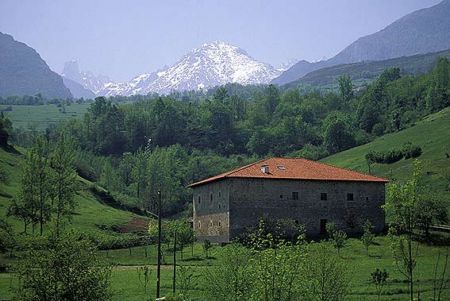
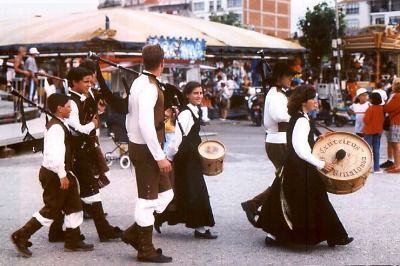
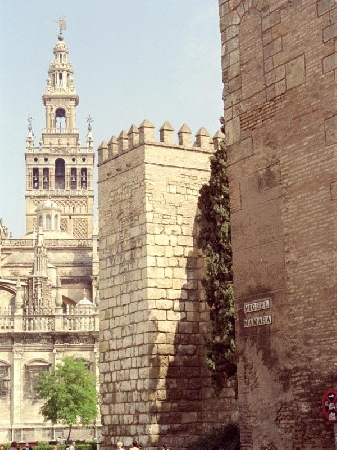
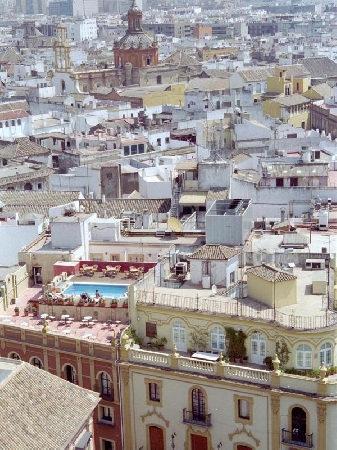
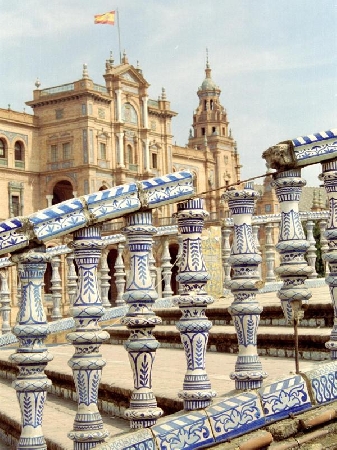
Another good excuse to come to the Sevillian capital are the festivals. The celebrations of Easter Week and Feria de Abril (the April Fair), which have been declared of National Tourist Interest, reflect the devotion and folklore of the people of Seville, always open and friendly to visitors. But Seville's appeal does not end there, as the city is also the starting point for the many cultural routes the province offers, such as the Roman Bética Route or the Washington Irving route. The visitor will also discover the immense natural wealth of this region, which sits halfway between two continents, in natural treasures such as the Doñana Nature Reserve, declared a World Heritage Site and Biosphere Reserve by UNESCO, and the Sierra Norte Nature Reserve. They will be the ideal setting for practising outdoor sports, including hiking, horse riding, and cycling routes. If, on the other hand, golf is your sport of choice, then you will be glad to know that Seville has four excellent golf courses in its vicinity.
The International Business and Culture study abroad program in Seville, Spain is designed for students who have 0-4 semesters of previous Spanish language study and a strong interest in business and economics. Students who are motivated to develop their Spanish language skills and learn about Spain and Europe through living in the traditional Spanish city of Sevilla will find that this program provides an ideal opportunity.
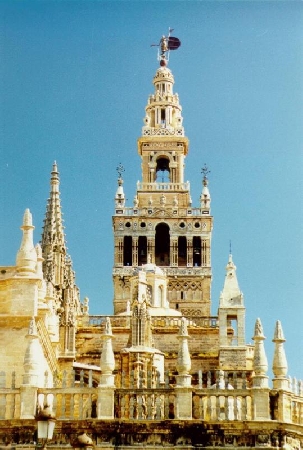
There is an amazing list of sights in Seville, Spain's most beautiful city according to most. It has an incredible appeal to both foreigners and Spaniards because of its light, the way Sevillanos enjoy themselves and its gorgeous architecture. Seville is one of the most romantic cities in Europe with a mixture of Roman reminiscences and Moorish traditions. So, without a doubt, you'll be pretty soon delighted by its charm and passion.
Being the top producer of olive oil in the world, it's only natural that this typically Mediterranean product plays a significant role in the Spanish diet. Add that to the cured hams from the nearby sierras and a whole lot of seafood brought in from neighboring Mediterranean and Atlantic towns and you’ve got an idea of Sevilla’s gastronomical treasures. Other dishes include huevos a la flamenca (eggs with tomato sauce), gazpacho (cold, vegetable-based soup), rabo de toro (bull's tail), and pescaíto frito (fried fish).
Tourists who don't leave the Barrio Santa Cruz and Cathedral area miss out on one of Seville's great pastimes, shopping. Make your way to Plaza Nueva then wander along Calles Sierpes, Tetuán and Velázquez where you'll find thousands of fashionable locals strolling around. Some are shopping, many are just window shopping and the rest are heading for a bar or café where they can spend their time people watching.
Sevilla [] ist die Hauptstadt der Autonomen Region Andalusien und der Provinz Sevilla von Spanien. Mit über 700. 000 Einwohnern ist Sevilla viertgrößte Stadt Spaniens. Nach einer späten Legende wurde die Stadt von dem griechischen Helden Herakles gegründet. Die Einwohner werden als Sevillanos bezeichnet.
Die Stadt ist ein wichtiger Industrie- und Handelsplatz und Touristenzentrum. Sevilla liegt zu beiden Seiten des bis hierhin schiffbaren Guadalquivir, in einer weiten und fruchtbaren Ebene. Mit ihren zahlreichen Türmen bietet Sevilla von allen Seiten einen imposanten Anblick. Die eigentliche Stadt nimmt das östliche Ufer des Guadalquivir ein und ist von den Vorstädten Los Humeros, Cesteria, Baratillo, Carreteria, Resolana mit dem großen Hospital La Caridad, San Bernardo, San Roque y la Calzada und Macarena mit dem Hospital de la Sangre umgeben. Von der alten, mit 66 Türmen versehenen Ringmauer, welche die innere Stadt umgab, sind nur noch Reste vorhanden. Am rechten Ufer des Flusses breitet sich noch die große Vorstadt Triana aus.
Description above from the Wikipedia, licensed under CC-BY-SA full list of contributors
here.